

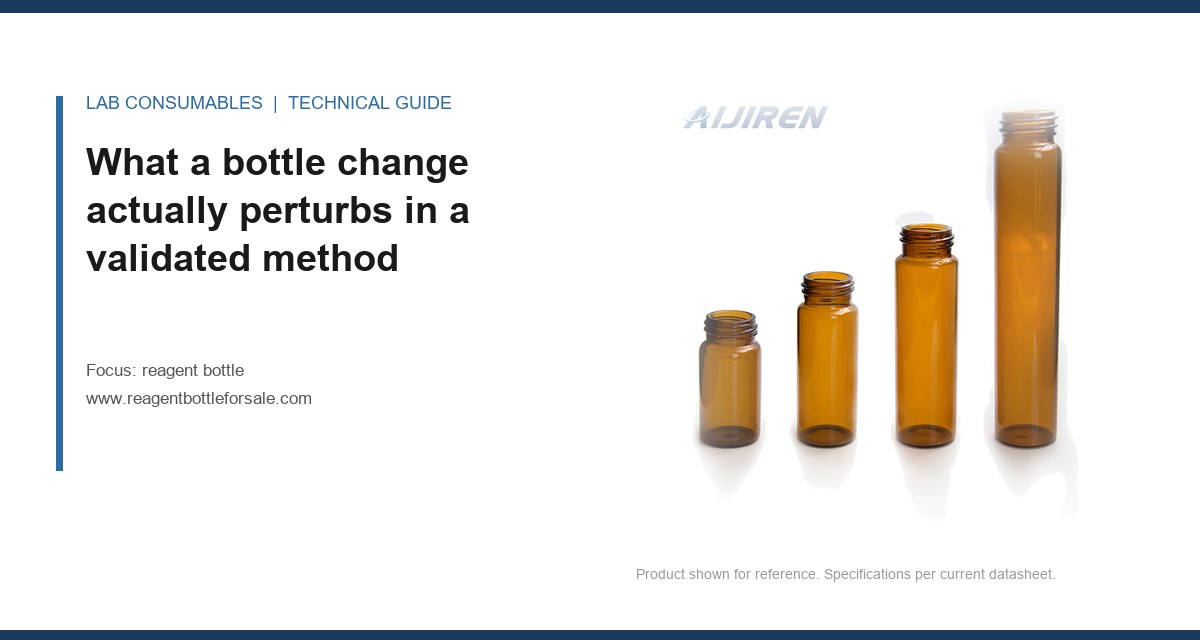
Lot 22-0417 of 40 mL clear screw-thread vials passed system suitability on Monday with a %RSD of 0.4 on six injections of the 100 µg/L check standard. On Thursday the same method on the same instrument gave 1.9 %RSD and a tailing factor of 1.6, and the only change on the bench was a fresh case of vials from a different supplier because the first one was backordered. That is the shape of the problem: the method is validated, the instrument is qualified, and a packaging change quietly invalidated both. Revalidation triggers when a reagent bottle supplier or lot changes are not a paperwork formality. They are the point where a validated method meets a new piece of plastic, glass, or PTFE and either survives or does not.
What follows is how I decide which bottle changes force a full revalidation, which need only a verification run, and how to write the change-control entry so that an inspector reads it and moves on rather than opening a finding. This is the operational decision, not the audit narrative and not the regulatory text, which the site covers elsewhere.
A reagent bottle is not inert by definition. It is a container with a surface, a headspace, a closure, and a manufacturing history. When any of those change, you are potentially changing four measured quantities at once, and a validated method is only validated against whatever values those quantities had during validation.
The first is leachables and extractables into the reagent. A switch from Type I borosilicate to Type III soda-lime glass, or from virgin PTFE to a reprocessed PTFE liner, changes what migrates into your mobile phase over a 30-day shelf life. Sodium, calcium, and boron are the usual suspects in glass; plasticizers and residual mold release agents are the usual suspects in closures.
The second is adsorption onto the interior surface. This bites hardest with low-concentration analytes and basic compounds. A bottle with a different surface treatment or a different annealing cycle can adsorb a few percent of a 1 µg/L standard, and you will see it as a calibration drift that looks like an instrument problem.
The third is headspace and closure permeability. A 500 mL bottle with a 28 mm GPI thread and a 3.0 mm liner is not the same container as a 500 mL bottle with a 24-400 thread and a 1.5 mm liner, even if both are labeled 500 mL. Vapor loss over a 14-day study can differ by a factor of two, and for volatile analytes that is a calibration failure waiting to happen.
The fourth is physical fit: autosampler geometry, tray height, cap torque, and the neck finish dimensions that determine whether your closure seals at all. That is a fit problem, and the reagent bottle you buy is only as good as the neck finish it was molded to.
Which changes force revalidation, and which only need verification
This is the decision that most change-control records get wrong, in both directions. People over-validate a liner swap and under-validate a glass source change. Here is the split I use, and it has held up through enough inspections that I am comfortable defending it.
Changes that force full revalidation
Full revalidation means the method’s performance characteristics are re-established: accuracy, precision, linearity, LOD/LOQ where relevant, and stability of the standard or mobile phase in the new container. It is expensive and slow, and it is the correct answer in these cases.
- Material class change. Type I borosilicate to Type III soda-lime, or virgin PTFE to a blended or reprocessed liner. Different leachables profile, different adsorption behavior. Revalidate.
- Surface treatment change. A silanized interior surface versus an untreated one, or a change in the dealkalization process. This is the one people miss because the drawing looks the same.
- Closure system change that alters permeability. A switch from a PTFE-faced silicone liner to a plain silicone liner, or a change in liner thickness by more than about 0.5 mm, changes vapor loss and must be revalidated for volatile analytes.
- Manufacturing process change at the source. A move from one molding line to another, a change in parison weight, or a change in the annealing schedule. The bottle looks identical and the extractables profile does not.
- Any change affecting a method with an LOQ below 10 µg/L. At trace levels, adsorption and leachables dominate. There is no shortcut here.
Changes that need only verification
Verification means you demonstrate the method still performs as validated, using a defined, small set of tests. It is a check, not a re-establishment. These cases qualify.
- Same supplier, same material class, same process, new lot number. This is the most common case and the one most over-treated. A lot change from a supplier with a stable process needs a verification run, not a revalidation, provided you have the supplier’s certificate of analysis and the neck finish dimensions match the drawing.
- Color change with no material change. Amber to clear, or clear to amber, when the glass type and process are identical. Verify that light exposure does not affect your analyte, then move on.
- Volume change within the same family. A 250 mL to a 500 mL bottle of identical construction. Verify headspace and stability, do not revalidate the whole method.
- Supplier change where the new supplier is qualified to the same specification and you have the dimensional and extractables data to prove it. Verify. Document the equivalence. Do not pretend it is a new method.
Decision table
| Change | Action | Minimum test set | Acceptance |
|---|---|---|---|
| New lot, same supplier, same spec | Verification | System suitability, 6 injections, plus a 7-day stability check on one standard | %RSD ≤ 1.0, tailing ≤ 1.5, recovery 98–102% |
| New supplier, same material and process | Verification plus equivalence dossier | Above plus extractables screen (ICP-MS for Na, Ca, B, Si) and neck finish dimensional check | Extractables within 20% of incumbent; dimensions within ±0.2 mm |
| Material class change | Full revalidation | Accuracy, precision, linearity, LOD/LOQ, stability | Per method validation protocol |
| Closure or liner change | Full revalidation for volatiles; verification otherwise | Vapor loss over 14 days, cap torque, system suitability | Loss ≤ 2% over 14 days; torque 15–25 in·oz for 24-400 |
| Surface treatment change | Full revalidation | Adsorption study at LOQ, plus accuracy and precision | Recovery 95–105% at LOQ |
| Process change at source | Full revalidation | Extractables, adsorption, stability | Per protocol |
The torque numbers matter. On a 24-400 screw thread with a PTFE-faced liner, I target 15 to 25 in·oz. Below 15 you leak; above 25 you cold-flow the liner and it fails on the second open. A closure change that alters the recommended torque is a revalidation trigger, not a verification one.
The verification run, in numbers
When a lot change only needs verification, I run a fixed protocol so that the result is comparable batch to batch. It takes about four hours and it has caught two real problems in five years.
Prepare a fresh 100 µg/L check standard in the new bottle and in a retained bottle from the previous lot. Inject six replicates from each on the same instrument, same column, same sequence. Compare %RSD, tailing factor, and retention time. Then store both at the method’s specified condition for seven days and re-inject. The acceptance criteria I use are %RSD ≤ 1.0, tailing ≤ 1.5, retention time within ±0.05 min, and recovery of the stored standard 98 to 102% of the day-zero value. If any of those fail, the lot change becomes a revalidation trigger and the change-control entry says so in writing.
For trace methods, add an extractables screen. Fill the new bottle with the mobile phase or diluent, hold it at 40 °C for 24 hours, and run the blank on ICP-MS for sodium, calcium, boron, and silicon. Compare to the incumbent. Anything above a 20% increase is a stop. This is the test that catches a supplier who quietly switched glass types, and it is the test that most labs skip.
Two field cases where the bottle was the variable
Case one: the sodium that was not in the water
A contract lab running cation analysis by ion chromatography saw a baseline sodium signal of about 0.8 mg/L in the method blank. The water system was checked and rechecked. The column was replaced. The signal persisted for three weeks and then vanished. The variable was a case of 1 L reagent bottles from a new supplier that had been used for the eluent reservoir. The bottles were Type III soda-lime, not the Type I borosilicate on the specification, and the supplier had shipped a substitution without a change notice. The measurement that identified it was an ICP-MS scan of a 24-hour leachate at 40 °C, which showed sodium at 4.2 mg/L against 0.3 mg/L in the incumbent. The fix was a supplier corrective action, a specification clause requiring material class on the certificate, and a verification protocol that now includes the leachate screen for every new supplier. The method did not need revalidation because the material was restored to the validated specification. The change-control entry documented the excursion and the restoration, and the inspector accepted it because the equivalence was demonstrated, not asserted.
Case two: the tailing factor that tracked the liner
A pharmaceutical QC lab running a basic analyte at 5 µg/L saw tailing factor climb from 1.1 to 1.8 over a two-week period, with recovery dropping to 91%. The instrument was qualified, the column was new, and the mobile phase was prepared fresh daily. The variable turned out to be a closure liner change: the supplier had moved from a 3.0 mm PTFE-faced silicone liner to a 2.0 mm liner with a different silicone formulation. The thinner liner compressed differently at the same torque, the seal was marginal, and the basic analyte was adsorbing onto the exposed silicone face. The measurement that identified it was a headspace vapor loss study over 14 days, which showed 6% loss against 1.5% for the incumbent, plus a torque audit that showed the new liner needed 22 in·oz to seal where the old one sealed at 16. That is a revalidation trigger. The lab revalidated the stability portion of the method, tightened the torque specification to 20 to 24 in·oz, and added a liner thickness check to incoming inspection. The lesson is that a liner is not a commodity. It is part of the container closure system, and the container closure system is part of the method.
Both cases share a structure: a measurable symptom, a measurement that isolated the bottle as the variable, and a documented fix that matched the size of the change. That structure is what an inspector is looking for.
Writing the change-control entry so an inspector accepts it
The entry is where good bench work goes to die. I have seen a lab do a textbook revalidation and still get a finding because the change-control record said “replaced bottle supplier, no impact on method” with no data behind it. The record has to answer four questions in order, and each answer has to be traceable to a document.
What changed, exactly. Not “new supplier.” The material class, the molding process, the neck finish dimensions (thread designation, T dimension, E dimension, H dimension), the liner material and thickness, and the lot number. If you cannot state those, you have not characterized the change and you cannot defend the decision.
Why that change is the category it is. State the rule you applied. “Material class unchanged, process unchanged, lot change only, therefore verification per SOP-xxx section 4.2.” An inspector will accept a rule applied consistently. They will not accept a judgment call with no rule behind it.
What you tested and what you found. The protocol, the acceptance criteria, and the raw data reference. Numbers, not adjectives. “%RSD 0.6 on six injections, tailing 1.2, recovery 99.4% at day seven” beats “acceptable results” every time.
What you did with the result. Either the change is accepted and the specification is updated, or the change is rejected and the incumbent is retained. Either way, the disposition is explicit and dated.
One more thing: link the entry to the supplier’s certificate of analysis and to your incoming inspection record. The traceability chain for a consumable has five links, and the change-control record is the link that ties the bottle in your hand to the specification the method was validated against. If that link is missing, the inspector has no way to know the bottle you tested is the bottle you are using. That is the finding, every time.
Where the change-control decision meets the rest of the lab
The bottle is not the only consumable whose change triggers revalidation, and the same logic applies to the vials that feed the autosampler. A switch in HPLC autosampler vial supplier changes the septa, the glass, and the crimp geometry, and any of those can move a %RSD. The same verification protocol applies. If you are qualifying a new vial, the sample vial specification should be checked against the autosampler’s tray height and needle depth before you run the study, because a fit failure will masquerade as a precision failure.
For the analytical side of the verification, the instrument vendors publish useful system suitability guidance. Agilent’s chromatography consumables and column resources and Thermo Fisher’s chromatography and sample handling pages both give the acceptance limits that most methods borrow. Restek’s technical resources are where I send new analysts to understand why a tailing factor moves when a liner changes. And if the method is a waste or environmental method, the container requirements trace back to EPA SW-846, which is where the specification for the bottle actually comes from.
If you are sourcing a replacement bottle and want the full picture of what you are buying, the chromatography products catalog is a reasonable place to compare neck finishes and liner options side by side. But compare the specification, not the price. The price difference between a qualified bottle and an unqualified one is a few cents. The cost of a failed verification run is a day of instrument time and a change-control entry you have to defend.
The decision rule
Treat a bottle change as a revalidation trigger if it alters the material class, the surface treatment, the closure system’s permeability, or the manufacturing process at the source. Treat it as verification if it is a lot change, a color change, a volume change within the same construction, or a supplier change you can prove is equivalent with dimensional and extractables data. Write the change-control entry with the rule, the protocol, the numbers, and the disposition, and link it to the certificate and the incoming inspection record. If you cannot state the neck finish dimensions and the material class of the bottle you are about to use, you are not ready to make the change, and no amount of verification data will fix a record that cannot identify what was tested.
References & further reading
Related resources from our lab consumables network:
- Reagent Bottle at reagentbottleforsale.com
- Hplc Autosampler Vial at hplcautosamplervials.com
- Sample Vial at samplevialprice.com
- Chromatography Products at chromatographyselling.com
External references and standards: