

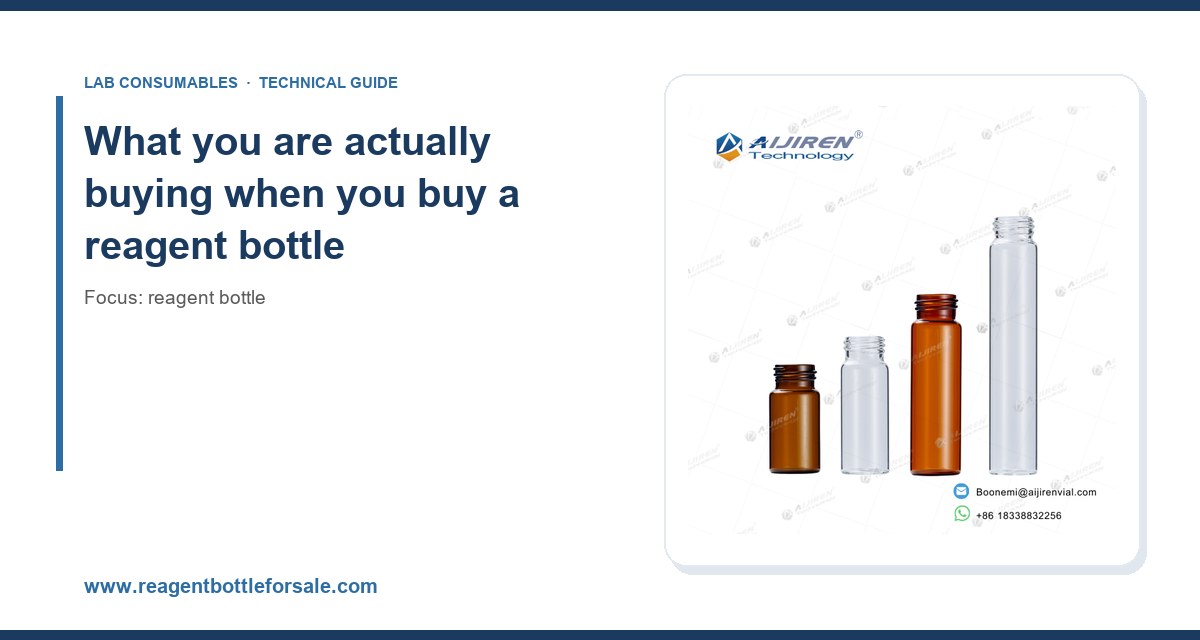
Last spring a procurement manager sent me a spreadsheet with eleven quotes for the same 500 mL borosilicate reagent bottle. The lowest was $2.14 per unit, the highest $9.80. Same nominal spec on paper. I’ve bought enough glass over the years to know that a 4.5x spread rarely means one supplier is gouging and another is a hero. It usually means the quotes describe different products, different packaging, different breakage allowances, and different ideas about what “MOQ” means. This article is what I told her, cleaned up and expanded.
A reagent bottle is a deceptively simple object: a glass or plastic body, a screw thread, a cap, and often a pouring ring or drip lip. The cost drivers hide in tolerances. A 1000 mL amber glass bottle with a GL45 thread and a polypropylene pour ring is not a commodity in the way a cardboard box is. The glass has to be annealed properly or it will craze under autoclaving. The thread has to be molded to a standard or your caps from supplier B won’t seal on bottles from supplier A. The graduations have to be printed with enamel that survives 121 °C steam cycles, or they flake off by month six and your analysts stop trusting the markings.
I’ve seen a batch of “borosilicate” bottles that turned out to be soda-lime glass with a borosilicate label. You find out when someone autoclaves them and the bottoms crack. The failure mode is not dramatic. You get a hairline fracture at the base radius, the bottle weeps slowly onto the shelf, and you discover it three weeks later when the reagent has evaporated to a crust. That is a procurement problem, not a lab problem, and it starts with how you write the specification.
If you are buying across a broader consumables list, the same logic applies to vials and caps. Our sister site covers HPLC autosampler vials in the same way, and the thread standards and septa questions are close cousins to what follows here.
Glass versus plastic: the first decision that sets your price band
Before you negotiate price, decide what material class you need. This single choice moves your unit cost by a factor of three or more and changes your supplier pool entirely.
Borosilicate 3.3 glass
Type I borosilicate (USP <660> Type I, ISO 3585) is the default for reagents that will be autoclaved, stored long term, or used with anything that leaches. Coefficient of thermal expansion around 3.3 × 10⁻⁶ /K. Autoclavable to 121 °C repeatedly, and to 140 °C if you must. Expect to pay $3.50 to $9.00 for a 500 mL clear bottle with a GL45 PP cap and pour ring at volumes under 5,000 units. Amber (light-protected) runs $0.40 to $1.20 more per unit because the amber glass batch is fussier.
Borosilicate 5.1 and neutral glass
Type II treated soda-lime and Type III soda-lime are cheaper, roughly $1.20 to $2.80 for 500 mL, and fine for short-term storage of non-critical reagents. I would not put them through repeated autoclave cycles. If a supplier quotes you $2.00 for a “borosilicate” 500 mL bottle, ask for the batch certificate and the expansion coefficient. If they can’t produce it, you are buying soda-lime.
PP, HDPE, and PFA
Polypropylene bottles (autoclavable, translucent, good chemical resistance, poor for solvents) run $0.90 to $3.00 for 500 mL. HDPE is cheaper still but not autoclavable and permeable to some vapors over time. PFA (fluoropolymer) is the outlier: a 500 mL PFA bottle can run $180 to $350 because it is essentially inert and used for trace-metal and ultra-pure work. You do not buy PFA by the pallet unless you have a specific trace analysis need.
Decoding the quote: what the price actually includes
A per-unit price is meaningless until you know what is bundled. I always ask for a line-item breakdown. Here is the checklist I use, with the numbers I expect to see.
- Cap included or not. Many quotes are body-only. A GL45 PP cap with a PTFE-faced silicone liner adds $0.35 to $0.90 per unit. A cap with a drip ring or a pour ring adds another $0.15 to $0.40. If two quotes differ by $1.50 and one includes caps, the gap may be nothing.
- Graduations and marking. Printed enamel graduations add $0.10 to $0.30. Laser-etched or fired ceramic markings cost more but survive autoclaving better.
- Certificates. A certificate of analysis (CoA) per batch is often free at volume but can be a $50 to $200 per-lot charge from smaller suppliers. An USP <660> conformity statement or an ISO 3585 declaration may be a separate document with its own fee.
- Packaging. Bottles ship in partitioned cartons or molded pulp trays. A well-packed pallet has a breakage rate under 0.5%. Cheap packaging shows up as a 3% to 8% breakage rate on arrival, and that cost lands on you, not the supplier, unless the terms say otherwise.
- Freight and duties. Glass is heavy and volumetric. A pallet of 500 mL bottles can weigh 400 kg or more. Ocean freight from Asia to a US port for a full container is one number; LCL and air freight are another. Always ask for the delivered unit cost (DDP) alongside the FOB or EXW price so you compare apples to apples.
I once compared two quotes where the “cheaper” supplier was EXW with no caps and no CoA, and the “expensive” one was DDP with caps, pour rings, and per-lot CoA. The delivered, fully-loaded cost was within 6%. The spreadsheet had lied because it only compared the headline number.
MOQ: what suppliers are really telling you
Minimum order quantity is where procurement and manufacturing reality collide. A glass bottle line has setup costs: mold changes, furnace ramp, annealing tunnel loading. A supplier quoting an MOQ of 10,000 units is not being difficult; they are telling you the batch size at which their line is economic. Here is how MOQs typically break down by supplier type.
Stocking distributors and catalog houses
MOQ is often 1 case (typically 10 to 24 bottles) because they hold inventory. Unit price is highest here, but you get next-day shipping and no setup cost. Good for pilots, method development, and topping up a shelf. If you only need a few hundred bottles a year, this is your lane and you should not fight it.
Regional manufacturers and converters
MOQ often lands at 500 to 5,000 units per size and color. They may waive setup if you take a standard catalog item. Custom marking (your part number, your logo, a specific graduation range) usually pushes MOQ to 5,000 to 10,000 because of the printing setup.
Offshore OEM factories
MOQ is typically 10,000 to 50,000 units per SKU for a full container load, sometimes less for mixed containers. Setup and tooling may be amortized into the first order. Lead time is 30 to 60 days plus ocean transit of 25 to 40 days to a US port. This is where the unit price gets genuinely low, but you carry inventory and you own the quality risk.
One practical move: ask whether the MOQ applies per SKU or per order. A supplier who says “10,000 minimum but you can mix sizes” is far more useful than one who says “10,000 per size.” If you buy 250 mL, 500 mL, and 1000 mL, a mixed-container MOQ can cut your inventory exposure by two-thirds.
How to evaluate a supplier: a scoring checklist
Price is the last thing I look at, not the first. Here is the evaluation framework I use, with the weights I apply for a typical reagent bottle program. Score each item 1 to 5 and multiply.
- Material certification (weight 25%). Can they produce a CoA with the glass type, expansion coefficient, and hydrolytic resistance class per batch? Do they hold ISO 3585 or USP <660> documentation? A 5 means documentation on demand; a 1 means “trust us.”
- Dimensional and thread conformity (weight 20%). Do their bottles match the GPI/GL thread standard so caps interchange? Ask for a drawing with thread pitch, diameter, and cap torque spec. GL45 means a 45 mm nominal thread; the cap torque is typically 1.5 to 2.5 N·m for a good seal without cracking the shoulder. If they can’t give you a drawing, they can’t control the thread.
- Quality system and audit history (weight 15%). ISO 9001 at minimum. Ask when their last third-party audit was and whether you can see the summary. A supplier who hesitates on this is telling you something.
- Sample performance (weight 15%). Order 50 to 100 units and test them. Autoclave three cycles, check for crazing. Fill with your actual reagent and store 30 days. Drop-test from 1 m onto concrete and count survivors. Measure cap torque with a torque wrench on ten bottles.
- Lead time and reliability (weight 15%). Ask for on-time delivery rate over the last 12 months. Anything below 95% is a warning. Ask what happens when they miss: do they air-freight at their cost, or do you wait?
- Commercial terms (weight 10%). Payment terms (Net 30 or better), breakage allowance, return policy, and whether they will hold safety stock for you.
Run this on three suppliers. The scores usually separate cleanly, and the cheapest quote is rarely the winner once certification and breakage are in the model.
Testing a sample batch: the numbers that matter
Never approve a supplier on paperwork alone. Order a sample lot and run these tests. I keep a one-page form for this and it has saved me twice.
- Autoclave cycling. Run 10 cycles at 121 °C for 20 minutes. Inspect for crazing, cloudiness, and base cracks. Any failure is a reject.
- Cap seal integrity. Fill with water, cap at 2.0 N·m, invert for 24 hours. Weigh before and after. More than 0.1 g loss on a 500 mL bottle means the liner or thread is suspect.
- Torque-to-failure. Tighten until the shoulder cracks or the cap strips. You want failure well above your working torque. If it fails at 3 N·m, your 2 N·m working torque has no margin.
- Drop test. Five bottles from 1 m onto concrete, filled to nominal. A good borosilicate bottle survives most drops; a bad one shatters at the base radius.
- Graduation durability. Scrub with a laboratory detergent and a stiff brush 20 times. Markings should remain legible. Enamel that rubs off is a reject.
- Chemical compatibility spot check. Store your actual reagent for 30 days at ambient and at 40 °C. Check for leaching, discoloration, or pressure buildup.
If you also buy vials and closures, run the same regime on sample vials. Septa and caps fail in the same ways, and a supplier who passes on bottles usually passes on vials.
Pricing benchmarks: what good looks like in 2024-2025
These are the delivered, fully-loaded ranges I see for standard catalog items at moderate volume (1,000 to 10,000 units). Treat them as a sanity check, not gospel, because resin and freight move.
- 100 mL clear borosilicate, GL45, PP cap, graduated: $1.80 to $4.20
- 250 mL clear borosilicate, GL45, PP cap, graduated: $2.40 to $5.50
- 500 mL clear borosilicate, GL45, PP cap, graduated: $3.50 to $9.00
- 1000 mL clear borosilicate, GL45, PP cap, graduated: $5.50 to $13.00
- 500 mL amber borosilicate, GL45: add $0.40 to $1.20 over clear
- 500 mL PP, autoclavable, graduated: $0.90 to $3.00
If a quote is more than 25% below the bottom of these ranges, ask why. The answer is usually thinner glass, no certification, no caps, or a different material class. If it is more than 25% above the top, ask what you are paying for. Sometimes it is a genuine premium (fire-polished lip, tighter tolerance, US-made); sometimes it is a catalog markup you can negotiate away.
Thread standards, caps, and the interchange trap
This is the detail that bites procurement teams hardest. GL45 is a de facto standard, but “GL45” on a datasheet does not guarantee interchangeability with every GL45 cap. Thread pitch, thread depth, and the sealing surface geometry vary between manufacturers. I have seen caps from one supplier leak on bottles from another even though both said GL45.
The fix is simple: standardize on one bottle supplier and one cap supplier, and specify the cap torque in your receiving inspection. If you must mix, buy a sample of each cap and test it on each bottle. A 10-minute test saves a month of mystery leaks. For reference, the GPI/GL thread standards define the nominal diameter and pitch; a GL45 cap has a 45 mm nominal diameter, and the common pitch is 4 mm. Ask your supplier to confirm the pitch and the sealing land diameter on the drawing.
For trace analysis work where caps and septa are critical, the same discipline applies to autosampler vial closures. A leaking cap on a reagent bottle ruins a shelf; a leaking cap on an autosampler vial ruins a run.
Operational precautions that affect what you should buy
Procurement decisions should reflect how the lab actually uses the bottle, not the datasheet ideal. A few operational realities to fold into your specification.
- Autoclave cycles. If bottles are autoclaved daily, specify Type I borosilicate and budget for replacement every 12 to 18 months. Soda-lime will fail sooner and fail unpredictably.
- Solvent storage. PP is poor for many solvents; glass is better but the cap liner matters. A PTFE-faced liner is the safe default for solvent contact. HDPE permeates some vapors over months.
- Light-sensitive reagents. Amber glass blocks most UV and visible light below about 550 nm. If your reagent is genuinely light-sensitive, amber is not optional, and the price premium is justified.
- Trace-metal work. Standard borosilicate leaches sodium and boron. For ppb-level work, PFA or quartz is the answer, and the price reflects it.
- Receiving inspection. Check a sample from every lot for cap fit, graduation legibility, and visible cracks. A 2-minute check per lot catches most supplier drift.
Troubleshooting checklist: when a supplier or a lot goes wrong
Even good suppliers ship bad lots. Here is the sequence I run when something fails.
- Bottles cracking at the base after autoclaving. Likely material or annealing problem. Pull the CoA, check the glass type, and quarantine the lot. Do not accept a “it’s normal” answer.
- Caps leaking or loosening in storage. Check torque and liner material. Measure the thread on a sample with calipers against the drawing. If the thread is out of tolerance, reject the lot.
- Graduations rubbing off. Enamel cure problem. Reject and ask for the firing temperature spec.
- High breakage on arrival. Packaging or handling. Photograph the carton, count the breakage, and file a claim within the carrier’s window (often 48 hours). Then renegotiate packaging with the supplier.
- Inconsistent cap fit between lots. Thread wear on the mold or a change in cap supplier. Ask for the mold maintenance log and the cap drawing.
- Lead time slipping. Ask for the production schedule, not the sales promise. If they cannot give you a ship date, assume the worst and activate your backup supplier.
For analytical work where the bottle feeds a chromatography system, the downstream consequences of a bad lot are worth understanding. Our chromatography products resource covers how sample handling failures show up as baseline noise and ghost peaks, and the technical libraries at Restek and Agilent are good references for method-level requirements. If your lab runs environmental work, the EPA SW-846 methods specify container and preservation requirements that your bottle spec must satisfy. And Thermo Fisher’s chromatography and sample handling pages are a useful cross-check on consumable compatibility.
A worked example: three quotes, one decision
Back to the procurement manager with eleven quotes. We narrowed to three and scored them.
- Supplier A: $2.14/unit, EXW, body only, no CoA, MOQ 20,000, 55-day lead time. Score: material 2, thread 2, quality 2, sample 3, lead time 2, terms 2. Weighted total: 2.1.
- Supplier B: $4.60/unit DDP, cap and pour ring included, per-lot CoA, MOQ 5,000 mixed sizes, 30-day lead time. Score: material 5, thread 4, quality 4, sample 4, lead time 4, terms 4. Weighted total: 4.3.
- Supplier C: $6.10/unit DDP, cap included, CoA plus USP <660> statement, MOQ 1,000, 10-day lead time from US stock. Score: material 5, thread 5, quality 5, sample 5, lead time 5, terms 3. Weighted total: 4.7.
Supplier A looked cheapest but the fully-loaded cost after adding caps ($0.55), CoA ($150/lot), freight, and a 4% breakage allowance pushed it to about $3.40 delivered, with a 55-day lead time and no quality documentation. Supplier B landed at $4.60 all-in with documentation and a workable MOQ. Supplier C was the safest but 33% more expensive. We split the award: C for the critical amber and trace-work bottles, B for the bulk clear stock, and A was dropped. The blended cost was about 12% above the naive lowest quote but eliminated the breakage and documentation risk.
Negotiation levers that actually move price
Once you have a qualified supplier, price is negotiable within a band. The levers that work, roughly in order of impact:
- Volume commitment. A 12-month blanket order with quarterly releases often buys 5% to 12% off list.
- Standard catalog items. Custom marking and custom sizes carry setup. Standard items are cheaper and faster.
- Mixed containers. Filling a container with multiple sizes lowers per-unit freight and can unlock the container-rate price.
- Payment terms. Net 45 or prepayment can buy a few percent, especially from smaller suppliers.
- Packaging simplification. Bulk-packed bottles (no individual cartons) cut packaging cost if your warehouse can handle it.
- Forecast sharing. A credible 12-month forecast lets the supplier plan furnace runs and hold safety stock, and they will price for it.
What does not work: threatening to leave for a supplier you have not qualified. Good suppliers know the switching cost, and an unqualified backup is not a real alternative.
Takeaway
Reagent bottle procurement is a specification problem before it is a price problem. Fix the material class and the thread standard, demand per-lot certification, test a sample batch against the numbers above (10 autoclave cycles, 2.0 N·m cap torque, 0.1 g seal loss, 1 m drop test), and score suppliers on documentation and lead time as heavily as on unit price. The cheapest headline quote is usually the most expensive delivered cost once caps, CoA, breakage, and lead time are in the model. Buy from a qualified supplier at a fair price, standardize on one thread standard, and keep a tested backup. That is the whole game.
References & further reading
Related resources from our lab consumables network:
- Reagent Bottle at reagentbottleforsale.com
- Hplc Autosampler Vial at hplcautosamplervials.com
- Sample Vial at samplevialprice.com
- Chromatography Products at chromatographyselling.com
External references and standards: