

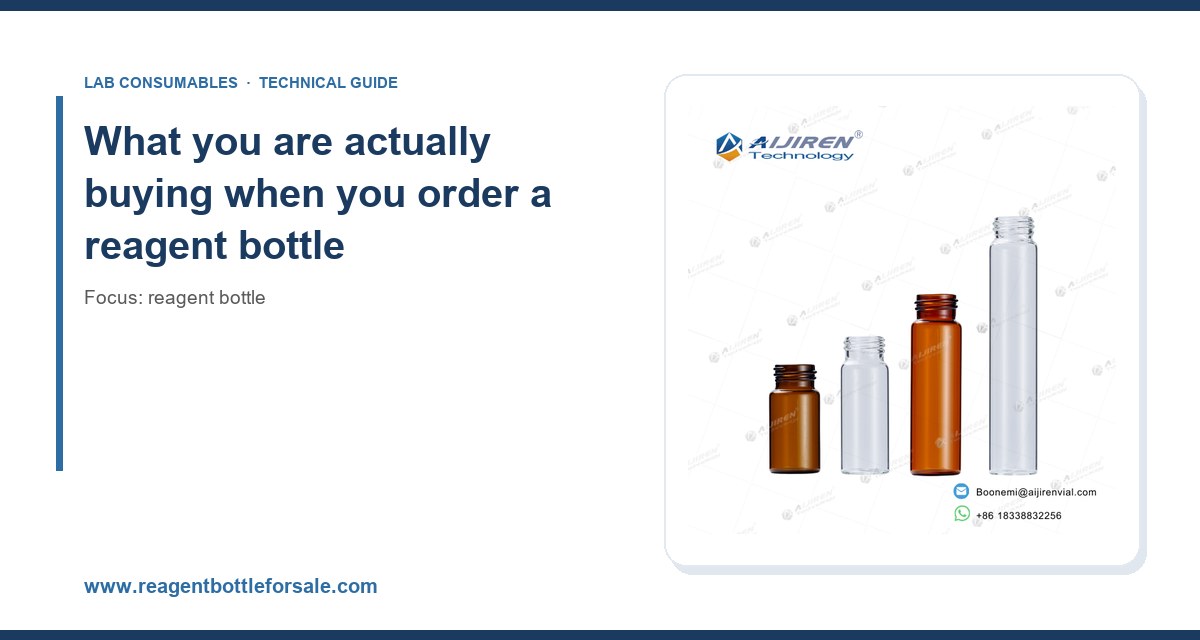
I have sat on both sides of this table. I spent eleven years buying borosilicate bottles for a contract lab, and another six selling them into pharmaceutical QA departments. The procurement conversations that went badly almost never failed on price. They failed because the buyer and the seller were using different definitions of “class A,” different assumptions about what a case of 24 actually contains, and different ideas about who eats the cost when a pallet arrives with chipped pour rings. This article is the version of that conversation I wish someone had handed me in 2009.
A reagent bottle is not a commodity in the way a cardboard box is. It is a molded glass or plastic pressure vessel with a ground joint, a pour ring, a cap with a liner, and a graduation that somebody will calibrate against. Every one of those elements has a spec, and every spec has a failure mode. If your purchase order says “500 mL amber glass bottle, GL45” and nothing else, you have written an invitation to substitute.
The main categories you will encounter in a lab supply chain:
- Borosilicate 3.3 glass bottles, typically 100 mL to 20 L, with GL32, GL45, or GL80 screw threads. Coefficient of expansion around 3.3 × 10⁻⁶ K⁻¹. Autoclavable at 121 °C, and the good ones survive repeated cycles to 140 °C in a dry sterilizer.
- Soda-lime glass bottles, cheaper, fine for non-critical storage of non-hydrolyzing solvents, but they leach alkali into aqueous solutions. I have seen pH drift of 0.3 units over six weeks in an unbuffered standard stored in soda-lime. Do not use them for trace-metal work.
- Amber glass, which is borosilicate with iron oxide tinting. Blocks below roughly 500 nm. If your method requires protection to 400 nm, ask for the transmission curve, not just the word “amber.”
- PTFE and PFA bottles, 30 mL to 4 L, for HF, trace metals, and ultrapure standards. PFA is translucent, PTFE is opaque white. Both are expensive, typically 6 to 12 times the cost of equivalent borosilicate.
- HDPE and PP bottles, the workhorses for buffers, bleach, and waste. HDPE is good to about 90 °C continuous, PP to about 120 °C.
If your workflow also involves autosampler positions, the bottle feeds into a different consumable chain. The reagent bottle is the reservoir; the HPLC autosampler vial is the thing that actually gets pierced. Both have to be qualified, and the qualification criteria are not the same.
Pricing: what the number on the quote actually represents
List prices for a 500 mL borosilicate GL45 bottle with a PP cap and PTFE-faced silicone liner run roughly $8 to $22 per unit in single-case quantities in the US market as of 2024. A 1 L version runs $11 to $28. A 2.5 L runs $22 to $48. Amber adds 15 to 25 percent. Graduated and certified versions add another 30 to 60 percent. PFA in 500 mL starts around $140 and climbs fast.
Those ranges are wide because the underlying cost structure is wide. The glass itself is a small fraction. What drives price:
Mold amortization and tooling
A new blow-mold or press-mold for a bottle body costs $15,000 to $60,000 depending on complexity. A supplier running a mold that has produced two million bottles amortizes that to near zero. A supplier running a new mold for a customer-specific neck profile has to recover it. If you are asking for a non-standard thread, expect a tooling charge of $8,000 to $25,000 and a minimum order that justifies keeping the mold on the shelf.
Glass quality tier
There are effectively three tiers of borosilicate on the market. Tier 1 is USP Type I, fully compliant, with a documented hydrolytic resistance per USP <660>. Tier 2 is “borosilicate” that passes Type I on a good day but has not been tested to the current standard. Tier 3 is soda-lime sold as borosilicate, which I have seen happen twice in twenty years and both times it was caught by a customer’s incoming inspection, not the supplier’s outgoing one. The price gap between Tier 1 and Tier 2 is often 20 to 30 percent. The gap between Tier 1 and Tier 3 is 50 percent. You get what you specify.
Cap and liner
The cap assembly is 15 to 30 percent of the landed cost and the single most common source of complaints. A GL45 PP cap with a PTFE-faced silicone liner is the default. A closed-top cap with a PTFE-faced EPDM liner is a different product with different solvent resistance. A cap with a pour ring (the little spout insert) adds $0.40 to $1.20 per unit. Specify which one you want, or you will get whichever the distributor has in the bin.
Certification and documentation
Certificate of analysis, certificate of conformance, dimensional report, and lot traceability are not free. A supplier who provides a lot-specific CoA with hydrolytic resistance data, dimensional measurements, and a batch number linked to a manufacturing date is doing real work. Expect a 5 to 15 percent premium over a supplier who provides a generic CoC. In regulated environments, that premium is not optional.
MOQ: the number that decides whether you can actually buy from a given supplier
Minimum order quantity is where most procurement negotiations die. The published MOQ is rarely the real MOQ. Here is what I have seen across the market:
- Distributors with stock: MOQ is one case, typically 10 to 24 units depending on size. Some will break a case for a fee of $25 to $75. Ask.
- Distributors who drop-ship from a manufacturer: MOQ is often one pallet, which for 500 mL bottles is 480 to 720 units. They will quote you a case price but the order will not ship until you hit the pallet.
- Direct-from-manufacturer in Asia: MOQ is typically 5,000 to 20,000 units per size, or one full 20-foot container (roughly 18,000 to 24,000 bottles for 500 mL). Tooling charges apply for non-standard specs.
- Domestic manufacturers: MOQ varies wildly, from 100 units for a stocked SKU to 10,000 for a custom run. A domestic manufacturer with a stocked catalog is often the best compromise for a lab that needs 2,000 units per year.
Three rules I have learned the hard way:
One: MOQ is negotiable, but only with a reason. A supplier will break an MOQ for a new customer if you commit to a 12-month forecast and a blanket PO. They will not break it because you asked nicely. Bring a forecast.
Two: watch the unit-of-measure trap. I have seen quotes where “case” meant 10, 12, 24, or 48 depending on the supplier. Get the case pack written on the quote in bold. I have also seen a supplier quote per bottle and ship per case, which is a 24x invoice surprise.
Three: freight is part of MOQ. A pallet of glass from a domestic warehouse costs $180 to $400 to ship LTL. A pallet from a port costs $1,200 to $2,800 including drayage and customs. If your MOQ forces you into a full container, the freight line on the quote is a bigger number than the product line. Model the landed cost, not the unit price.
How to evaluate a supplier: the eleven-point checklist
I use a fixed checklist for any new reagent bottle supplier. Score each item pass, conditional, or fail. Two fails and I do not place a first order larger than a single case.
1. Do they publish a real spec sheet?
Not a marketing page. A spec sheet with dimensions, wall thickness tolerance, capacity tolerance, graduation accuracy, cap torque recommendation, and temperature limits. If the spec sheet says “high quality borosilicate glass” and nothing else, that is a fail. Ask for the dimensional drawing. A serious supplier has one.
2. Can they name the glass type and the standard?
USP Type I, ASTM E438 Type I, ISO 3585. These are the references. A supplier who cannot name one of them is not a glass supplier, they are a reseller of unknown goods.
3. Is the cap torque specified?
This is my favorite screening question because it separates the real manufacturers from the traders. A properly engineered GL45 cap with a PTFE-faced silicone liner has a recommended torque of 1.5 to 2.5 N·m for a leak-tight seal without crushing the liner. A supplier who knows this will tell you in one sentence. A supplier who does not will change the subject. Torque matters because under-torqued caps leak in transit and over-torqued caps crack the neck on the second autoclave cycle.
4. What is the puncture or autoclave rating?
For septa and liners, ask for the puncture count. A standard silicone/PTFE liner is good for 3 to 5 punctures before it leaks. A butyl rubber liner is good for 1 to 2. For autoclave cycles, a borosilicate bottle should survive 50+ cycles at 121 °C without crazing. Ask for the test data. If they do not have it, they have not tested it.
5. Do they provide a lot-specific CoA?
A CoA that lists the lot number, manufacturing date, hydrolytic resistance class, and dimensional results is a real CoA. A CoA that is the same PDF for every lot is a marketing document. Ask for two CoAs from different lots and compare.
6. What is the dimensional tolerance on the neck?
For GL45, the thread major diameter is nominally 45 mm with a tolerance of about ±0.3 mm. The bottleneck bore is typically 30 mm ± 0.5 mm. If the neck is out of tolerance, caps cross-thread and leak. Ask for the tolerance. A supplier who quotes ±1 mm is telling you they do not have a controlled process.
7. What is the incoming inspection protocol?
Ask how they check incoming glass. A serious distributor samples every lot for dimensional conformance, visual defects (bubbles, stones, checks), and cap fit. A trader does not inspect at all. Ask for the inspection record format. If they cannot produce one, they are a trader.
8. What is the packaging spec?
Glass in a cardboard box with no dividers will arrive broken. A proper case has molded pulp or foam dividers, a minimum 3 mm wall clearance, and a double-wall corrugated outer. Ask for the packaging spec and a photo of a packed case. I have rejected entire pallets because the supplier switched from pulp dividers to a plastic bag.
9. What is the lead time and the lead time variability?
Quoted lead time is the average. What you need is the 95th percentile. Ask for the last six months of on-time delivery data. A supplier with a 4-week average and a 12-week worst case is a supplier who will miss your audit. A supplier with a 6-week average and a 7-week worst case is a better partner.
10. What is the return and replacement policy for breakage?
Standard is replacement of any unit broken in transit, with photo documentation, within 30 days. Anything less is a fail. Anything more (replacement plus freight) is a bonus. Get it in writing on the quote.
11. Can they support the regulatory documentation you need?
If you are in a GMP environment, you need a supplier who can provide a technical file, a change control notification process, and a quality agreement. If you are in an environmental lab running EPA SW-846 methods, you need a supplier who understands that the bottle is part of the method’s sample integrity chain. Ask a method-specific question and see if they can answer it.
A comparison table you can actually use
Here is the decision matrix I use when a lab asks me to recommend a sourcing route. Numbers are typical for a 500 mL amber borosilicate GL45 bottle with a PP cap and PTFE-faced silicone liner, 2024 US pricing.
| Route | Unit price | MOQ | Lead time | Documentation | Best for |
|---|---|---|---|---|---|
| Domestic distributor, stocked | $14 to $22 | 1 case (10 to 24) | 2 to 5 days | CoC, sometimes CoA | Small labs, urgent needs, method development |
| Domestic manufacturer, direct | $9 to $16 | 100 to 1,000 | 3 to 6 weeks | Full CoA, technical file | Mid-size labs with a forecast |
| Import, LCL | $5 to $10 | 1 pallet (480 to 720) | 8 to 14 weeks | CoA if specified | Cost-driven, non-regulated |
| Import, FCL | $3.50 to $7 | 1 container (18,000+) | 10 to 16 weeks | CoA, inspection report | Large distributors, OEM |
| PFA specialty supplier | $140 to $260 | 10 to 50 | 2 to 8 weeks | Full traceability | Trace metals, HF, ultrapure |
Note the pattern: the unit price falls by roughly 70 percent from the top row to the bottom, but the working capital tied up in inventory rises by two orders of magnitude. A container of 18,000 bottles at $5 each is $90,000 of inventory. If your lab uses 4,000 bottles a year, that is a 4.5-year supply. The unit price is a lie unless you divide by the inventory turn.
Where the money actually goes: a worked example
Take a lab that uses 6,000 bottles of 500 mL amber borosilicate per year. Three sourcing scenarios:
Scenario A: domestic distributor, stocked. $18/unit × 6,000 = $108,000/year. No inventory beyond a month. No tooling. No freight surprises. Documentation is a CoC.
Scenario B: domestic manufacturer, direct. $12/unit × 6,000 = $72,000/year. Requires a 12-month blanket PO and a 3-month safety stock (1,500 units, $18,000 tied up). Documentation is a full CoA. Lead time is 4 weeks.
Scenario C: import, FCL. $5/unit × 18,000 = $90,000 for a container, plus $2,400 freight and $1,800 duties, landed $94,200. That is 3 years of supply. Annualized cost is $31,400/year, but you have $94,200 in working capital tied up for 3 years, plus warehouse space, plus the risk of a bad lot you cannot return. If the lot fails incoming inspection, you eat it.
The naive read is that Scenario C wins. The honest read is that Scenario C wins only if your annual usage is above about 12,000 units and you have a qualified incoming inspection program. Below that, Scenario B is the sweet spot. Scenario A is the right answer for any lab under 2,000 units per year or any lab that cannot forecast.
Operational precautions that affect procurement
Several bottle failures I have investigated were caused by procurement decisions, not manufacturing defects. Worth knowing before you sign:
Autoclave cycles and cap choice
A PP cap will deform after about 20 cycles at 121 °C. A PBT cap or a PPS cap will go 100+ cycles. If your protocol autoclaves the bottle with the cap on, specify a high-temperature cap. If you autoclave with the cap loose (which you should, to prevent pressure differential), a PP cap is fine. The procurement spec should say which.
Solvent compatibility with the liner
A PTFE-faced silicone liner is the default for aqueous and most organic solvents. It is not good for prolonged contact with chlorinated solvents at elevated temperature. For DCM or chloroform storage, specify a PTFE-faced EPDM liner or a solid PTFE liner. The liner is $0.30 to $1.50 of the unit cost and the cause of most “the bottle leaked” complaints I have fielded.
Graduation accuracy
A “graduated” bottle is not a volumetric flask. The tolerance on a 500 mL graduated bottle is typically ±5 percent, and on a 1 L it is ±5 percent. If your method requires volumetric accuracy, you need a volumetric flask, not a reagent bottle. Do not let a procurement spec conflate the two. I have seen a method validation fail because someone assumed the bottle’s graduation was Class A.
Light protection
Amber glass blocks below about 500 nm at 2 mm wall thickness. If your analyte is light-sensitive at 450 nm, amber is marginal. Specify amber plus an opaque secondary container, or move to a PFA bottle with a black outer sleeve. Ask for the transmission curve at 400, 450, and 500 nm. A supplier who cannot provide it is guessing.
Troubleshooting checklist for incoming lots
When a new lot arrives, run this before you put it into inventory:
- Visual: inspect 10 percent of the case for bubbles, stones, checks, and mold seams. Reject the lot if more than 1 unit in 24 has a visible defect.
- Dimensional: measure the neck major diameter on 5 units. GL45 should be 45.0 ± 0.3 mm. Measure the bottleneck bore. 30.0 ± 0.5 mm is typical.
- Cap fit: torque a cap to 2.0 N·m on 5 units. It should seat without cross-threading and hold pressure at 1 bar for 60 seconds with no leak.
- Autoclave: run 3 units through 5 cycles at 121 °C. Inspect for crazing and check cap deformation.
- Documentation: match the lot number on the CoA to the lot number on the case. If they do not match, reject.
- Graduation check: fill to the 500 mL mark with water at 20 °C and weigh. Tolerance is ±5 percent for a graduated bottle. If it is off by more, the lot is mislabeled.
If any two items fail, return the lot. If one item fails, quarantine and ask the supplier for a replacement lot with a fresh CoA. Document the failure. Suppliers who get a documented rejection tend to improve; suppliers who get a phone call do not.
Where the bottle fits in the wider consumable chain
The reagent bottle is the upstream end of a chain that runs through the autosampler vial, the septum, the cap, and the column. If you are negotiating a supply agreement, negotiate the chain, not the bottle. A distributor who can supply the bottle, the sample vial, and the septa on one PO with one freight line is worth a 5 to 10 percent premium over a supplier who can only do the bottle. I have seen labs save 18 percent on the bottle and lose 22 percent on freight and expediting because the bottle supplier could not ship the vials.
If you are building a broader chromatography consumables program, the reference material matters as much as the price. Agilent publishes detailed chromatography consumables and column specifications that are useful for cross-checking a supplier’s claimed compatibility. Thermo Fisher’s chromatography and sample handling documentation covers the vial and cap side of the chain in detail. Restek’s technical resources are the best free reference I know for septum and liner selection. Use them as a benchmark when a supplier’s spec sheet is vague. And if you are sourcing the whole chain, the chromatography products catalog is a useful starting point for comparing what is in stock versus what is quoted.
What I recommend, concretely
For a lab using under 2,000 bottles per year: buy from a domestic distributor with stock, accept the 15 to 25 percent premium, and do not sign a blanket PO. Your forecast is not good enough to justify it, and the working capital cost of a container is higher than the unit price savings.
For a lab using 2,000 to 12,000 bottles per year: negotiate a 12-month blanket PO with a domestic manufacturer. Target a unit price of $10 to $14 for 500 mL amber borosilicate GL45, a 4-week lead time, a full CoA per lot, and a 3-month safety stock. Specify the cap torque (2.0 N·m), the liner (PTFE-faced silicone), the glass standard (USP Type I / ASTM E438 Type I), and the neck tolerance (±0.3 mm). Put the case pack in writing. Require a 30-day breakage replacement policy.
For a lab using over 12,000 bottles per year: import is worth modeling, but only with a qualified incoming inspection program and a supplier who will provide a pre-shipment inspection report from a third party. Budget 10 to 16 weeks of lead time and 3 years of inventory. If you cannot commit to that, stay domestic.
For any lab using PFA or trace-metal-grade bottles: buy from a specialty supplier, not a general distributor. The documentation and the cleaning protocol matter more than the unit price, and the unit price is high enough that a bad lot hurts.
One last number: the total cost of a reagent bottle in use is roughly 2 to 3 times the purchase price once you account for cleaning, autoclaving, documentation, and disposal. A bottle that costs $18 and lasts 50 cycles is cheaper than a bottle that costs $9 and lasts 15. Price per cycle, not price per unit, is the number that should be on your scorecard.
Takeaway
Reagent bottle procurement is a specification problem disguised as a price problem. Write the spec first: glass type and standard, dimensions and tolerances, cap and liner, torque, temperature rating, documentation, packaging, and MOQ. Then shop the spec, not the catalog. The supplier who can answer eleven checklist questions in writing is worth a 10 percent premium over the one who cannot. The supplier who cannot answer three of them is not a supplier, they are a risk. And the unit price on the quote is meaningless until you divide it by the number of autoclave cycles the bottle actually survives and add the freight, the inventory carrying cost, and the cost of the lot you had to reject.
References & further reading
Related resources from our lab consumables network:
- Reagent Bottle at reagentbottleforsale.com
- Hplc Autosampler Vial at hplcautosamplervials.com
- Sample Vial at samplevialprice.com
- Chromatography Products at chromatographyselling.com
External references and standards: